Evidence-First, You-Led Care
My name is Allie Caddell and I am a birth photographer in Knoxville, TN.
I had the pleasure of connecting with Aly Salas in Maryville, TN.
I’ve had the honor to work with Aly at a few births, but we never had the opportunity to chat in depth, so here is a little bit about Aly and our conversation when I interviewed her.
For each midwife, my goal is to have a unique summary of the midwives here in Knoxville and surrounding areas because each one has a unique perspective and all have a genuine heart to help women feel empowered and safely birth at home.
These interviews allow me to better explain to future clients what makes each midwife unique.
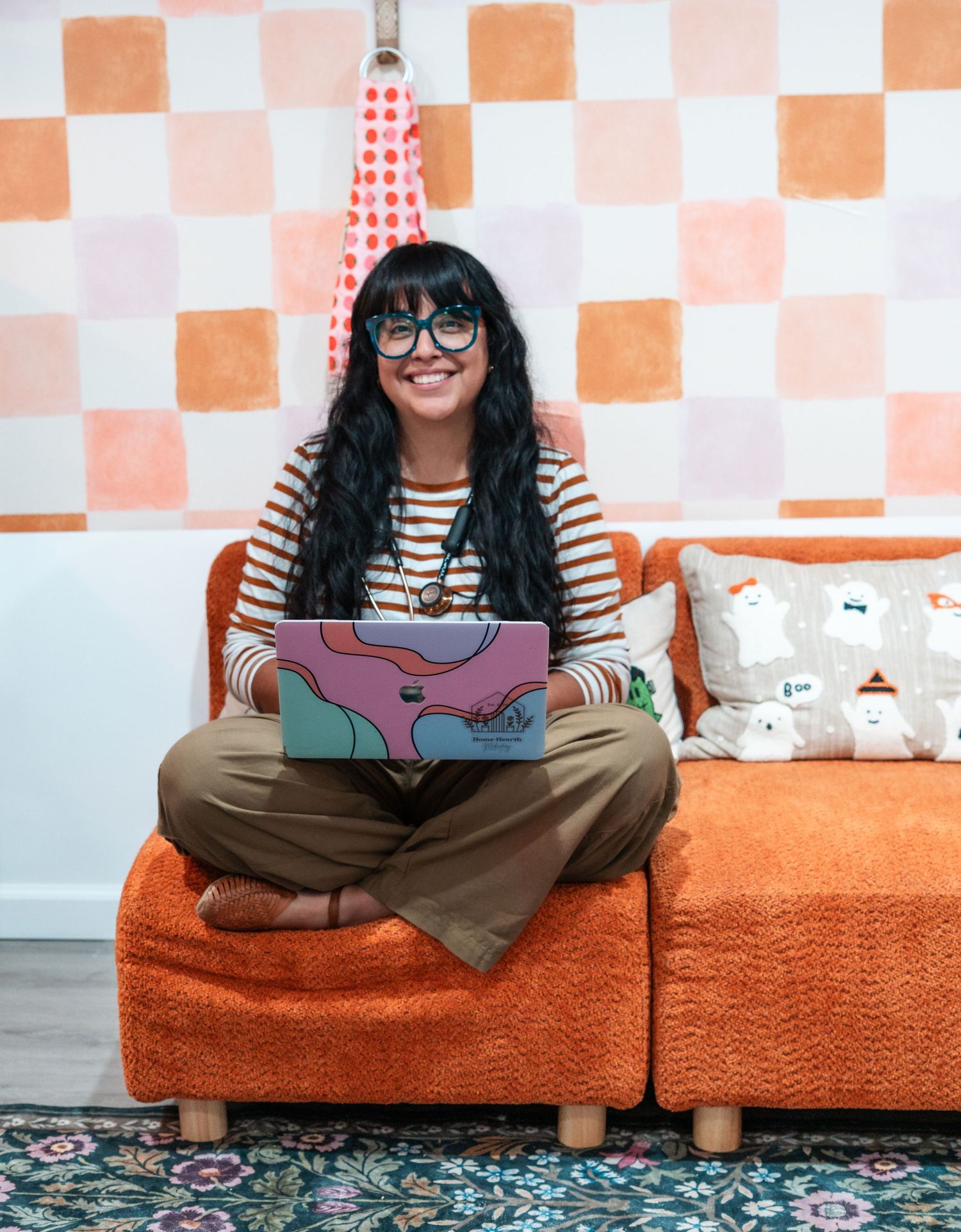
Aly Salas at Home + Hearth | 1004 W Broadway Ave, Suite #1 Maryville, TN 37801
So without further ado, let’s talk about Aly Salas.
A conversation with a holistic midwife on herbs, informed choice, home birth fit, transfers, twins, IVF, postpartum, and placenta encapsulation.
Allie Caddell (Knoxville Birth Photographer): I like to tell people that every midwife has a “lane” some are more medically focused, some more holistic. What would you say is your niche? And what’s your “shtick,” if you will?
Aly Salas, Midwife: I like to say I’m holistic, like, I’m treating your whole body.
If you’ve got something going on, we’re going to try to fix it with food and movement. And if not, then we can supplement with supplements or herbs.
Herbs are my thing. I make tinctures, salves, and teas. Herbs have so many nutrients, and it’s easy to get them in that form.
Supplements are great too, but most of the time they’re pills and as a pregnant woman, you’re already taking, like, a million pills.
So that’s something I’m like, “Okay, let’s do that last. Let’s see what we can incorporate into your diet. What can we add in the form of a tea?”
This is really hands-off. I like everybody to lead.
I have clients who really want their hand held and want a lot of input and support and want my opinion.
It’s really hard as a provider to give a medical opinion, let’s say on circumcision or vitamin K, because we all have our things, right?
So I really try to deliver evidence-based care like here is what the research says about it.
And when they ask me, “What did you do for your kids?”
I’m always like, “Ask me at your two-week appointment, and I’m happy to tell you.
But right now, I don’t want to influence you. I want you to pick what is best for you all.”
If that is circumcision, I can tell you who the best circumcision doctor is, and that’s who I want you to go to.
If you don’t want to circumcise, I’ll provide you with care instructions.
It’s really just, you are the boss. You are in charge. Here is the information. You tell me what you want me to do.
Allie Caddell (Knoxville Birth Photographer): I love that. It keeps people from second-guessing later.
Aly Salas, Midwife: Exactly. You’ve got to take responsibility for the kind of care that you want, because this is a choice, right?
And I hate to say it and I know people hate to hear it but home birth isn’t for everybody.
There are high-risk things that risk you out of having a home birth.
And also, if you’re somebody who doesn’t want to make decisions, doctors will do that for you easily.
If that’s what brings you peace, then that’s probably who’s best for you.
But if you want to follow evidence, if you want to do your own research, if you want the choices, and you’re low-risk, home birth is totally an option.
Only 1% of families in Tennessee have a home birth, which is wild. That’s a statistic from last year.
Allie Caddell (Knoxville Birth Photographer): I love that you say home birth isn’t for everyone.
I’ve seen some people who don’t want to educate themselves and the outcomes reflect it and that’s unpopular to say outloud.
Aly Salas, Midwife: As a midwife, you’re “supposed to” say home birth, home birth, home birth but real talk.
I had clients in the past who only did prenatal care with us, but changed her mind knowing at the end she wanted a hospital birth.
I’m never going to try to convince you not to have a C-section.
If that’s what you want, let’s do it.
Here’s what it’s going to be like.
Here’s recovery time.
Here are some extra things you’ll have to do afterwards.
If that’s what you want, it’s not the bad choice.
There is no bad choice, it’s what works for you.
These moms who change their decisions can still have a very positive birth experience.
Skin-to-skin contact is still possible, and some may feel safer having a hospital birth due to past trauma from family history.
However, the trauma is individual, and even siblings can have vastly different birth experiences
Allie Caddell (Knoxville Birth Photographer): About herbs and oils, some people say essential oils in the birth pool or too many tinctures can increase bleeding. What’s your take?

Aly Salas, Midwife: There are so many tinctures.
In pregnancy, the ones I recommend are infusions like NORA tea: nettles, oatstraw, red raspberry leaf, and alfalfa.
You can take it as tea or tincture.
What’s really popular right now is “birth prep tincture.”
I don’t make it, and I don’t really recommend taking tinctures to “prepare” for birth. One of those has cohosh, a uterine stimulant. The bottle says start at 36 weeks, which isn’t even term.
Think of it like your baby getting micro-dosed and your body trying to go into labor that early.
That’s not one I recommend, even though people say, “Oh yeah, do it, I had an easier time.”
Allie Caddell (Knoxville Birth Photographer): How do you prepare families for transfer or high-risk situations?
Aly Salas, Midwife: They always ask, “What would transfer me out of care?”
The list is long and not comprehensive because everybody’s different, but it’s always a possibility.
In my interview, before you hire me, I say: just because you’re hiring a midwife does not mean you’re going to have a home birth.
Home birth is not a guarantee. I love home birth, but my goal is to have both of you safe. If that’s at home, awesome.
If it’s not, that’s okay, and I’m going to be there too.
Family history matters. If there is history of high blood pressure in your family, I may monitor a little more closely if there are other risk factors present.
Did you have preeclampsia last time? What can we do to mitigate it this time?
If you had gestational diabetes last time, it’s not an automatic “you’re out.”
It’s: what can we do?
Diet, exercise, and there are a couple of supplements that help bring down those numbers.
Constant education, asking questions, making sure I answer yours. I never want someone to leave my office thinking, “She didn’t tell me anything about this.”
Start a notes tab on your phone. You’ll think of things in the middle of the night, write them down and bring them.
Allie Caddell (Knoxville Birth Photographer): What about twins?
Aly Salas, Midwife: I’m comfortable with twins, certain kinds. “MoMo” twins (one sac, one placenta) are the most risky.
In this particular situation, you would no longer be a candidate for home birth and we would transfer your care to the hospital.
If they’re sharing a sac but have two placentas, or two sacs and two placentas, or two sacs and one placenta, those can be fine.
It involves more collaboration with high-risk, more frequent visits and ultrasounds than a singleton.
I only require the anatomy scan for singles, but with twins we watch growth to avoid twin-to-twin transfusion.
I’ve delivered twins at home successfully. It’s a bigger team, I want five to six extra people so each baby has two, in case they need something.
I have an assistant and someone to chart everything because it gets busy.
Allie Caddell (Knoxville Birth Photographer): And IVF pregnancies?
Aly Salas, Midwife: IVF moms can absolutely have a home birth.
IVF carries its own risks, but it’s totally possible.
I don’t do anything “extra” automatically, the risks are personal.
If you have a history of X, Y, Z, I’ll watch that more closely. “Advanced maternal age” at 35 is a label we created.
I have plenty of women who give birth past 35. It’s different for everyone. You can always do an extra test or two tied to whatever risk is attached to that diagnosis.
Allie Caddell (Knoxville Birth Photographer): What led you to this work?
Aly Salas, Midwife: I wanted to be the person in my community who sits down for an hour and talks to you, not at you.
I want to teach you how important it is to nourish your body and care for yourself.
I am the person who says, “Hey, diet is important."
Baby doesn’t need an extra 500 calories a day.
Let’s focus on protein. Let’s move.
Let’s do pelvic floor therapy,” which is now covered by insurance. It can teach you how to push.
You don’t have to be incontinent for the rest of your life.
My grandmother thought leaking was normal after babies.
It’s not.
You can fix it with a few exercises and you learn that from a provider who has time to sit with you.
My births were fine; I just had no clue.
I don’t remember my hospital appointments ever being longer than 20 minutes.
With my last baby homebirth was illegal and Certified Professional Midwives (what I am) weren’t recognized as providers.
I’d never met the midwife who delivered him.
Later, at my six-week postpartum, I thought: I barely saw anyone.
With midwifery I build relationships; it’s hard to just part ways. I stay friends with a lot of my clients. They visit when they can and I get to see how big and beautiful baby has gotten!
Allie Caddell (Knoxville Birth Photographer): What does postpartum support look like with you?
Aly Salas, Midwife: The normal standard is one-day, two-week, and six-week. I offer a four-week, too, because the month between two and six is long.
I pay for a lactation course in pregnancy, if you get a class, you’ll learn basics and won’t feel overwhelmed. The consultant checks in after birth.
You’re more likely to reach out if you’ve already met her.
Otherwise, you might just ride the struggle bus and tough it out
She’ll loop me in if there are issues like flat nipples, ties, holds to try. We can prep for first latch. Those old “toughen them up with a washcloth” tips are outdated (and painful).
Especially for first-time moms, you don’t know what you don’t know, and it’s hard to ask for help.
Education changes the whole experience.
Allie Caddell (Knoxville Birth Photographer): What about, placenta encapsulation, what do you offer?
Aly Salas, Midwife: For my clients, it’s $250 and you get the capsules, a salve (great for cradle cap, rashes, eczema), a tincture, and a little cord keepsake.
The tincture will last you for the rest of your life, it’s 100% alcohol-based with some of your placenta in powder form. It works like the pills but faster, because there’s no digestion.
During PMS, menopause, or high stress, you have it on hand.
I pick up placentas from hospitals. You can add the package on if you’re not my client, but it costs more because I’m not already at your house.
At hospitals now it’s easy. Some require a form saying you’re taking it home and releasing it to me. Others just hand it over.
I’ve picked up from UT, Fort Sanders, Tenova, all over. You walk in with a cooler, say whose placenta it is, and they bring it out.
Allie Caddell (Knoxville Birth Photographer): Final word on “prep” products?
Aly Salas, Midwife: Birth-prep tinctures aren’t my thing. Some include cohos, a uterine stimulant, starting at 36 weeks, which isn’t term.
It’s essentially micro-dosing your baby and nudging labor early. I don’t recommend that.
Allie Caddell (Knoxville Birth Photographer): Awesome. Well, I think that's it. On the interview side. Thank you for your time today!
To wrap this all up, Aly Salas, a holistic midwife, is all about nutrition, movement, and herbal remedies for pregnant women.
She makes her own tinctures, salves, and teas to avoid unnecessary pills.
Aly believes moms should be empowered to make informed decisions with education and resources. We all know there are a lot of opinions online, especially in the crunchy community, but she encourages clients to research and make choices that align with their values.
She avoids giving personal opinions to make sure her beliefs don’t influence decisions.
During the interview, she clarified that home birth isn’t for everyone.
Hospitals can provide providers who make every decision, while home birth might be a good option for low-risk, choice-seeking moms who enjoy—or are willing to do—the research.
Last, she does offer such helpful uses for a placenta.
I’ve never seen a birth worker create so many helpful products.
She makes capsules, a salve for rashes, a long-lasting tincture, a cord keepsake, and even does hospital pickups (cooler in hand).
Personally, I’ve never seen a birth worker create so many helpful products out of one placenta, so I think it’s wonderful that she uses it for multipurpose needs.